Problems Hub
What you're seeing and whether it's urgent.
Foundation problems show up in your house, not in your foundation. Pick the symptom that matches what you're seeing. Each page has photos, what causes it, how urgent it is, and how we fix it.
Pick the symptom
What you're seeing in your home
Bowing Basement Walls
Severity
Urgent — call same day
A bowing basement wall is in active structural failure. The wall is being pushed inward by sustained hydrostatic pressure from saturated soil behind it. Deflection of 1/2 inch from plumb is the threshold for inspection. Over 1 inch is a 24-hour emergency. Repair uses carbon fiber strips, steel I-beams, or wall anchors to brace the wall, plus drainage correction to address the pressure source. Typical cost $3,500 to $12,000.
How to fix it →
Horizontal Foundation Cracks
Severity
Urgent — call same day
A horizontal crack across a basement wall at mid-wall height is an emergency. It indicates the wall is bending inward under hydrostatic pressure from saturated soil. Unlike vertical cracks which are often cosmetic, horizontal cracks are nearly always structural. Inspection within 24 to 72 hours is the appropriate timeline. Repair typically runs $5,000 to $12,000 because both the wall (carbon fiber or steel bracing) and the drainage system need work.
How to fix it →
Water in Basement
Severity
Urgent — call same day
Water in the basement comes from one of four sources: surface runoff (gutters, grading), hydrostatic pressure on walls or floor joints, indoor plumbing leaks, or sewer backup. Diagnosis identifies the source, then the repair targets that source. Surface-runoff fixes cost $500 to $3,000. Hydrostatic-pressure waterproofing costs $2,300 to $7,600 per Bob Vila's May 2024 cost guide. Plumbing leaks are a separate plumber call.
How to fix it →
Floor and Slab Cracks
Severity
Structural — schedule inspection
Floor cracks fall into two diagnostic categories. Hairline cracks under 1/16 inch in a slab floor, especially in a random network pattern, are typically shrinkage cracks from concrete curing and are cosmetic. Wider cracks, cracks with displacement, or recently-appeared cracks are likely settlement cracks indicating soil movement beneath the slab. Repair runs $250 to $800 for sealing cosmetic cracks, scaling to $3,500 or more for slab repair with settlement.
How to fix it →
Foundation Cracks Guide
Severity
Structural — schedule inspection
Foundation cracks fall into four diagnostic types: vertical (often cosmetic from concrete curing), horizontal (urgent, from hydrostatic pressure), stair-step (almost always structural, from differential settlement in brick veneer), and floor (variable, slab shrinkage vs settlement). Severity depends on width, direction, location, and progression. Hairline vertical cracks under 1/16 inch are usually safe to monitor. Cracks over 1/8 inch in any direction warrant professional inspection.
How to fix it →
Gaps Around Windows
Severity
Structural — schedule inspection
Gaps around windows come from three main causes: failed caulk (most common, cosmetic), wood-frame seasonal movement (minor), or foundation settlement that has racked the wall framing away from the window frame. The diagnostic key is the gap pattern. Uniform gaps that match all four sides of the window are likely caulk. Gaps that widen toward the top of the window or toward one side indicate foundation movement. Pairing with brick cracks or sticking windows confirms structural cause.
How to fix it →
Sloping Floors
Severity
Structural — schedule inspection
Sloping floors are typically a foundation-settlement symptom. The residential threshold for structural concern is 1/2 inch of drop over a 10-foot span, measured with a 4-foot level or by rolling a marble across the floor. Slope under 1/4 inch over 10 feet may be original construction tolerance. Slope over 1 inch is active settlement requiring near-term repair. Repair cost typically $5,000 to $20,000 depending on foundation type and severity.
How to fix it →
Stair-Step Foundation Cracks
Severity
Structural — schedule inspection
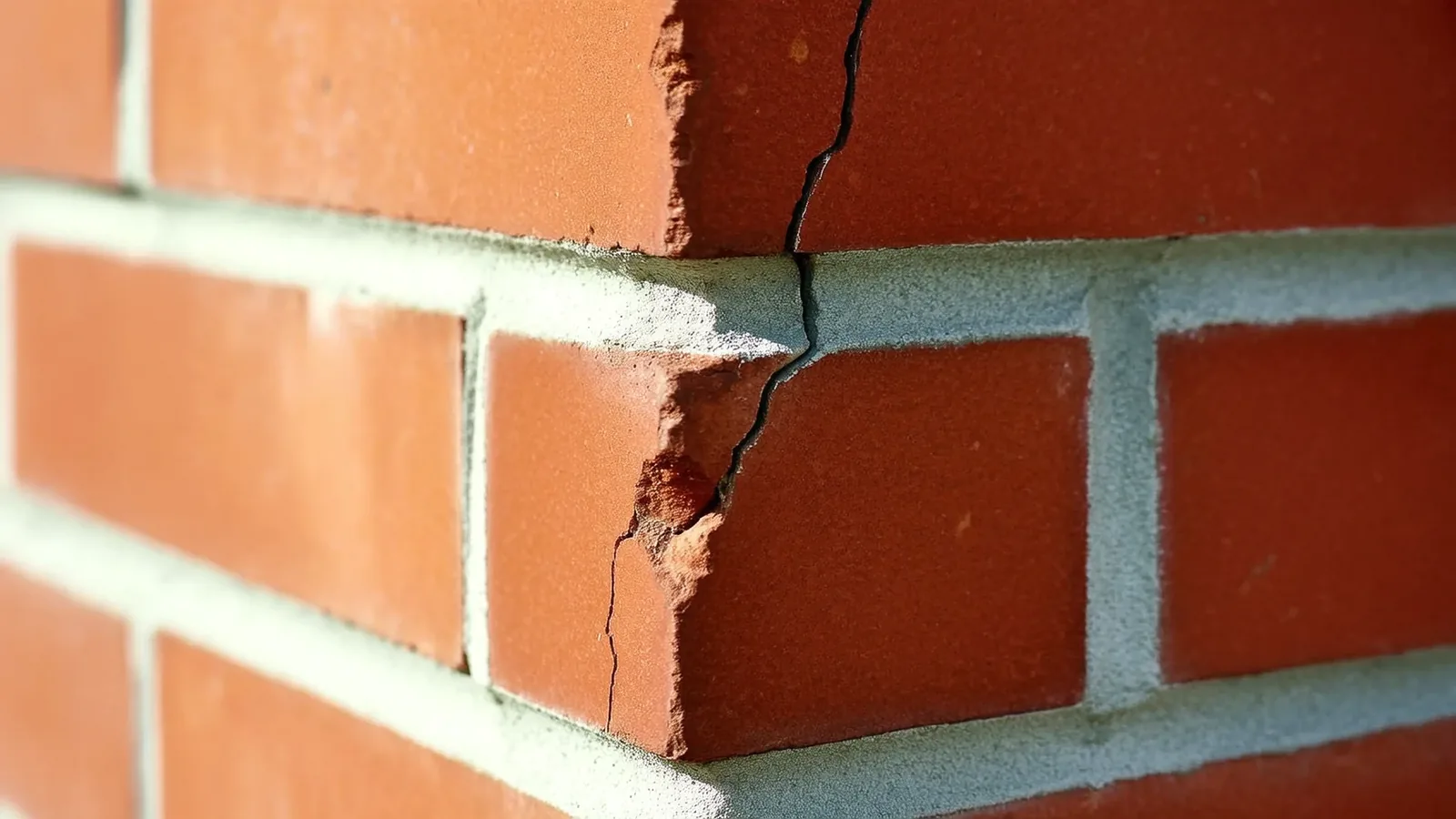
Stair-step cracks track the mortar joints in brick veneer or masonry block walls in a characteristic diagonal pattern. Nearly always structural rather than cosmetic. The pattern forms because differential settlement at one corner of the foundation racks the rigid brick along yielding mortar lines. Repair requires underpinning the settled corner before repointing the affected mortar. Typical cost $5,000 to $15,000.
How to fix it →
Sticking Doors and Windows
Severity
Structural — schedule inspection
Sticking doors and windows are often the first interior symptom homeowners notice when a foundation begins to settle. Telling foundation-driven sticking from seasonal humidity sticking is the diagnostic key: foundation sticking appears suddenly without prior history, persists across seasons, often affects multiple openings in one area of the home, and pairs with exterior brick cracks. Underpinning the affected section of foundation is the fix.
How to fix it →
Vertical Foundation Cracks
Severity
Cosmetic — monitor
Vertical cracks are the least urgent foundation crack type. Hairline vertical cracks under 1/16 inch in poured concrete walls usually come from normal curing shrinkage and are cosmetic. They become structural concerns only when they widen past 1/8 inch, show displacement between the two sides, or visibly progress month to month. Repair starts at $250 to $800 per crack for sealing per Bob Vila's May 2024 cost guide.
How to fix it →
Free written quote
Not sure how urgent your symptom is?
On-site inspection diagnoses the cause and tells you whether it can wait or needs same-week action. Written diagnosis within 24 hours.
Common questions
Foundation problem questions, answered first.
- What are the most common foundation problems?
- The five most commonly reported foundation problems are exterior cracks (vertical, horizontal, or stair-step in brick and block), bowing basement walls under soil pressure, sloping or uneven floors detectable with a level, water seepage into basements or crawlspaces, and sticking doors or windows that did not stick before. Each indicates a different underlying issue and a different repair path.
- How do I tell if foundation damage is serious vs cosmetic?
- Foundation damage is serious if a crack is wider than one-eighth of an inch, runs horizontally across a wall, or shows displacement where one side has moved relative to the other. Stair-step cracks tracking the mortar joints in brick are nearly always structural. Hairline vertical cracks in concrete walls, by contrast, often come from normal curing and may be cosmetic.
- What causes foundation damage?
- Three causes drive most foundation damage in the Tennessee Valley: expansive-clay soil movement from seasonal wet-dry cycles, hydrostatic pressure from poor drainage around the foundation, and inadequate footing depth on older homes whose footings sit within the active soil-movement zone. Tree roots near foundations and plumbing leaks contribute in a smaller percentage of cases, often by amplifying the soil-movement problem.
- Can foundation problems be fixed without major repair?
- Some foundation problems can be resolved with drainage corrections rather than structural repair. Extending downspouts to discharge water 6 to 10 feet from the foundation, regrading soil to slope away from the house, installing French drains, and removing tree roots within 10 feet of footings can stabilize a foundation showing only minor seasonal movement. Significant cracks or settlement need professional assessment.
- When should I call a foundation expert?
- Call a foundation expert when any crack reaches one-eighth-inch wide, when doors or windows suddenly stop closing, when a basement wall shows visible bowing, or when standing water appears repeatedly in the basement or crawlspace. Urgency is highest for horizontal wall cracks, active settlement detectable over a few months, and any crack with visible displacement between the two sides.
- How fast do foundation problems get worse?
- Foundation damage typically progresses slowly, over months to years, but accelerating events can reduce that timeline sharply. A clay-heave problem worsens fastest during the first wet-dry cycle after the trigger event, often within 3 to 6 months. Active water intrusion can cause measurable wall movement in weeks. Stable hairline cracks may not progress for years if drainage is corrected.