★★★★★
"Showed up the same day I called. Quote was written on the spot. No upsell. Two days, three-man crew. Brick line is back where it should be."
Marcus T. Hixson, TN · 4 helical piers, bracket install
Service · Chattanooga
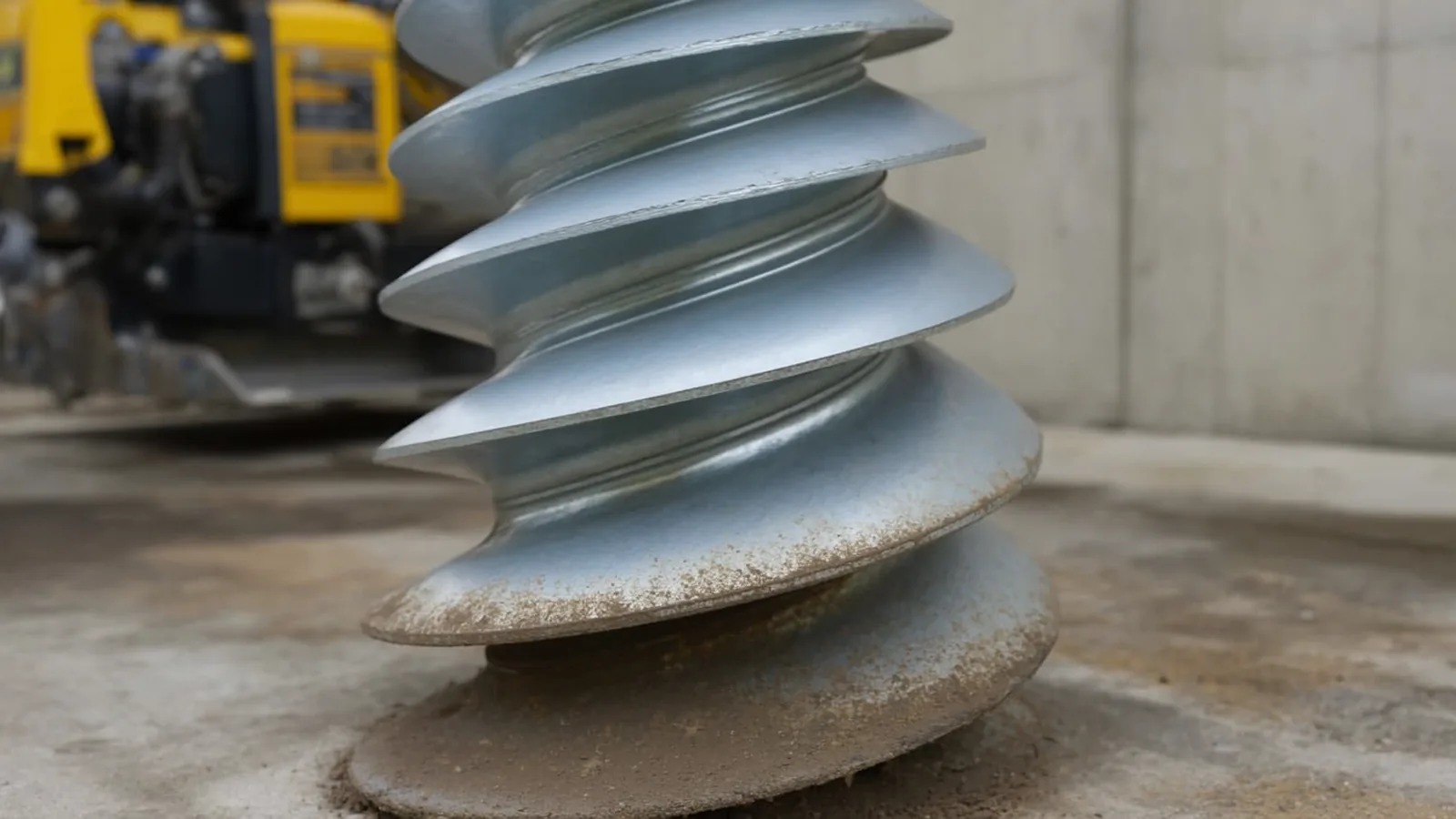
Helical piers are steel shafts with helix-shaped bearing plates that are rotated into stable soil using a hydraulic torque motor. Once installed, brackets transfer the foundation load from settled surface soils onto the pier shaft. Cost is $1,000 to $3,000 per pier per Bob Vila's May 2024 cost guide, with most residential jobs requiring 6 to 12 piers. Installation typically takes 2 to 3 days.
Helical piers are the right tool when a settling foundation needs to transfer load onto deeper, stable soil. We install them daily across the Tennessee Valley on slab homes, additions, and tight-access lots where heavy push-pier equipment cannot reach. Every project starts with a free written elevation survey, so you know exactly what you are paying for before any pier touches the ground.
What helical piers is
A helical pier is a steel shaft with helix-shaped bearing plates welded near the lead end. A hydraulic torque motor rotates the pier into stable soil. Once at depth, a steel bracket transfers the foundation load from settled surface soil onto the pier shaft.
Free written inspection
Get my free inspection →Same-day inspections in most cases. No-obligation written quote.
When to choose this
Helical piers are preferred when the bearing layer is deeper than push piers can reach, when access is tight, or when the building is not heavy enough to drive a push pier down to bearing capacity.
Our process
We measure foundation elevation at multiple points, document the bow or settlement pattern, and calculate the load the piers will need to carry. You get a written report whether or not you hire us.
We mark pier locations against the elevation survey, dig a small excavation pit at each location, and stage the pier shafts and bracket hardware. Yard impact is limited to the pit footprint.
A hydraulic torque motor rotates each pier into the ground. We monitor torque in real time and stop when the reading confirms the pier has reached soil with adequate bearing capacity. Drive depth typically runs 8 to 24 feet for the Tennessee Valley.
A steel bracket attaches to the existing footing and the pier shaft. We transfer the building load from the settled surface soil onto the pier. If you want lift back toward original elevation, we do that here.
We backfill the excavation pits, restore the grading, and walk you through the elevation measurements before and after. You get the documentation for your records and for any future resale.
Key facts
Lifespan
25+ years
Install time
2-3 days
Cost per pier
$1,000-$3,000
Warranty
Transferable
Comparison
| Factor | Helical Piers | Steel Push Piers |
|---|---|---|
| Bearing mechanism | Helix bearing + skin friction | End-bearing on dense soil or bedrock |
| Best soil profile | Soft surface, intermittent bearing layers | Stable bearing within reach, heavier surface soils |
| Best for loads | Light to medium residential | Heavy residential, larger structures |
| Equipment footprint | Smaller, tight-access capable | Larger, requires more open work area |
"Showed up the same day I called. Quote was written on the spot. No upsell. Two days, three-man crew. Brick line is back where it should be."
Marcus T. Hixson, TN · 4 helical piers, bracket install
Method details
A helical pier is a length of round or square steel shaft with one or more helix-shaped steel plates welded near the leading end. Installation uses a hydraulic torque motor mounted on a skid steer or a smaller handheld unit, which rotates the pier into the ground. As the helix bites into the soil, the pier advances downward, similar to a screw entering wood. The installer monitors torque continuously and stops when the torque value indicates the pier has reached soil with adequate bearing capacity to support the building’s load.
Once at depth, the installer attaches a steel bracket to the existing footing. The bracket transfers the building’s load from the settled surface soil onto the new pier. On exterior installations, the bracket is bolted to the side of the footing. On interior installations, the bracket is positioned beneath the footing through a small excavation. After bracket attachment, the structure can be lifted back toward its original elevation if differential settlement has occurred.
The helix plates are the load-bearing element. Each helix generates bearing capacity by pressing against the soil above and below it, and large piers may carry two or three helix plates of increasing diameter. This helix-bearing mechanism allows helical piers to develop capacity in softer soils where simpler end-bearing piers would require much greater depth.
Helical piers are the preferred method on four common scenarios:
Expansive clay soils, which swell when wet and shrink when dry [Wikipedia: Expansive clay], can make helical piers preferable because the helix depth can be tuned to reach below the active soil zone.
The two methods solve the same problem (transfer a settling foundation’s load onto stable bearing soil) using different mechanics. The right pick depends on three factors:
Decision rule: pick helical piers when access is tight, soils are soft, or the building is light. Pick steel push piers when bearing is shallow and the building has enough mass to drive the pier home.
A typical residential helical pier project on 6 to 12 piers takes 2 to 3 days, broken down roughly as follows:
Heavy spring rain delays exterior pier work because saturated soils cannot support the hydraulic torque equipment safely. Interior installation in basements and crawlspaces avoids weather delays but adds 25 to 30 percent to per-pier cost because of the more limited working conditions.
Per the Bob Vila Foundation Repair Cost guide (May 2024), piering and underpinning runs $1,000 to $3,000 per pier. Most residential projects need 6 to 12 piers, producing total project costs roughly $6,000 to $36,000 before bundled work like drainage, interior cosmetic repairs, or basement sealing.
Factors that move cost within the range:
For full method-by-method comparison see the foundation repair cost guide.
Helical pier warranties typically come in two layers. The manufacturer warranty covers the pier system itself (the steel components, the helix plates, the bracket) against material defects and corrosion failure for 25 years or longer. The installer warranty covers workmanship and the stabilization result, often for 25 years and typically transferable to subsequent homeowners. See the foundation warranty guide for what to confirm in writing before signing.
Questions
Free written quote
On-site inspection with elevation survey. Written quote within 24 hours. No obligation.