Service · Chattanooga
Steel Push Piers in Chattanooga
Steel push piers are hydraulically driven sections of galvanized steel tubing that reach stable bearing soil or bedrock beneath a settling foundation. The hydraulic ram uses the building's own weight as the reaction force to push each pier section to refusal. Cost is $1,000 to $3,000 per pier per Bob Vila's May 2024 cost guide. Installation takes 2 to 4 days on a typical 6 to 12 pier residential project.
Steel Push Piers in Chattanooga: Top Guide to Installation, Cost & Refusal Depth
Steel push piers are hydraulically driven sections of galvanized steel tubing that reach stable bearing soil or bedrock beneath a settling foundation. The hydraulic ram uses the building's own weight as the reaction force to push each pier section to refusal. Cost is $1,000 to $3,000 per pier per Bob Vila's May 2024 cost guide. Installation takes 2 to 4 days on a typical 6 to 12 pier residential project.
Free written inspection
Get my free inspection →Same-day inspections in most cases. No-obligation written quote.
Comparison
Steel Push Piers vs Helical Piers
| Factor | Steel Push Piers | Helical Piers |
|---|---|---|
| Capacity source | End-bearing on dense soil or bedrock | Helix bearing plus skin friction |
| Driving force | Hydraulic ram using building weight as reaction | Hydraulic torque motor rotating the pier |
| Best soil profile | Stable bearing within 30 feet | Soft surface, intermittent bearing |
| Best building type | Heavier (brick, masonry, two-story) | Lighter (frame, single-story, additions) |
Method details
More on steel push piers
How Steel Push Piers Work
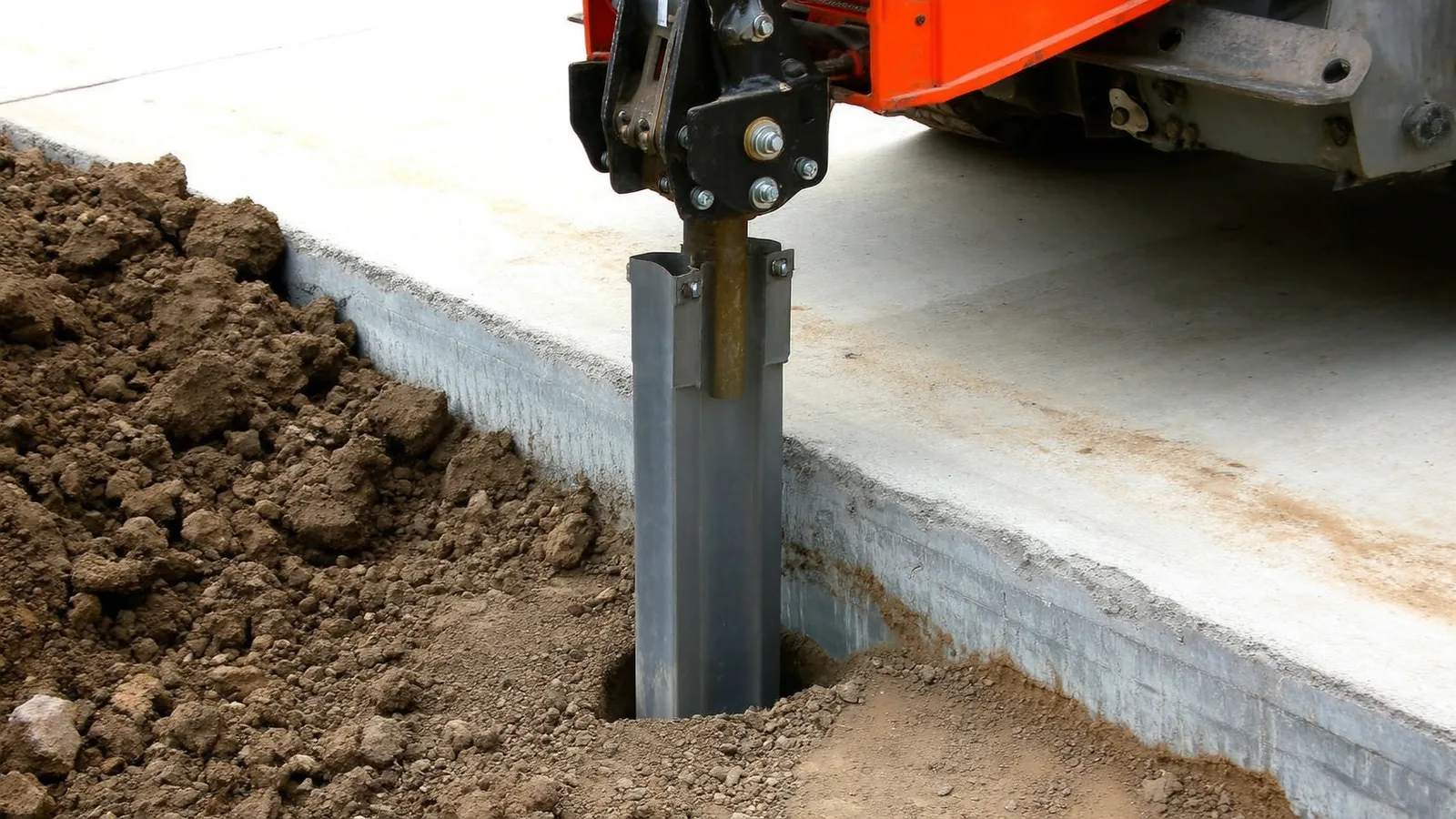
A steel push pier is a section of round, galvanized steel tubing that is hydraulically pushed into the ground beneath an existing foundation. Installation begins with a small excavation at the foundation footing to expose the bottom of the slab or beam. A steel bracket is then bolted to the footing. A hydraulic ram is mounted on the bracket, pointing downward, and starts pressing the first pier section into the soil. As each section is driven home, a coupler joins the next section to the top of the previous one, and the ram continues pressing.
The reaction force that pushes the pier downward comes from the building itself. The hydraulic ram pushes the pier down, and Newton’s third law pushes the building up. The installer monitors the pressure gauge on the ram during driving. When the reading reaches a threshold value (refusal pressure) and stays there as additional pier sections are added, the pier has reached a bearing layer with the required capacity. The pier is then locked off at that depth and the load transfers from the foundation onto the steel column.
What “refusal” means
Push piers do not generate capacity by friction along the shaft or by helical plate bearing. They generate capacity purely by end-bearing on the dense soil or bedrock at the pier tip. Refusal is the pressure at which the pier stops advancing under the building’s reaction force, indicating the bearing layer has been reached. Refusal depth varies by site; a typical Tennessee Valley installation reaches refusal somewhere between 15 and 30 feet, though shallower and deeper depths are not unusual.
When Steel Push Piers Are the Right Method
Push piers are preferred under four specific scenarios:
- Heavier residential structures. Two-story homes, brick-veneer construction, and homes with masonry exteriors have enough mass to reliably drive pier sections to refusal. Lighter structures may not.
- Accessible bearing layer. Where dense soil or bedrock is within roughly 30 feet of the surface, push piers can reach it efficiently. Beyond 30 feet, helical piers or alternative deep-foundation methods become more economical.
- Open equipment access. Push pier installation needs more working room than helical pier installation. The bracket and ram assembly is larger.
- Verified capacity required. Because each pier is driven to a measured refusal pressure, push pier installations document load-bearing capacity on every pier during installation, which can be useful for buyer-side disclosure.
Steel Push Piers vs Helical Piers
Push and helical piers are the two main underpinning methods. The differences are about how each generates capacity:
Decision rule: pick push piers when the building has the mass and the bearing layer is shallow enough. Pick helical piers when surface soils are soft, the building is light, or access is tight.
Installation Sequence and Project Length
A typical 6 to 12 pier project takes 2 to 4 days. The wider time range compared to helical piers reflects the uncertainty in refusal depth: a single pier hitting refusal at 28 feet takes substantially more time than one hitting refusal at 14 feet. Sequence:
- Day 1: Excavate at all pier locations, bolt brackets to footings, begin driving first piers
- Day 2 and Day 3: Continue driving piers to refusal, couple new sections as needed
- Final day: Lock off piers at refusal, transfer load, optional structural lift, backfill
Heavy rain causes the longest delays on push pier installations because saturated soils both complicate equipment access AND temporarily reduce the building’s reactive bearing capacity, which can prevent piers from reaching reliable refusal until soils dry.
Cost Drivers
Per Bob Vila’s May 2024 Foundation Repair Cost guide, piering runs $1,000 to $3,000 per pier. Typical 6 to 12 pier residential project totals run $6,000 to $36,000. Variables that move cost:
- Number of piers needed (severity-driven)
- Refusal depth (deeper drives use more pier sections)
- Site access (interior vs exterior placement)
- Bracket type (heavy-duty for larger structures)
- Lift requirement (structural lift adds engineering)
See the foundation repair cost guide for full method-by-method comparison.
Warranty
Steel push pier warranties run 25 years on both the manufacturer system and the installer workmanship, typically transferable to subsequent homeowners. See the foundation warranty guide for the specifics to verify in writing.
Questions
Common steel push piers questions
What are steel push piers and how do they work?
When are steel push piers the right choice?
How much do steel push piers cost?
How long do steel push piers last?
Steel Push Piers vs Helical Piers, which is better?
Free written quote
Ready for your steel push piers quote?
On-site inspection with elevation survey. Written quote within 24 hours. No obligation.